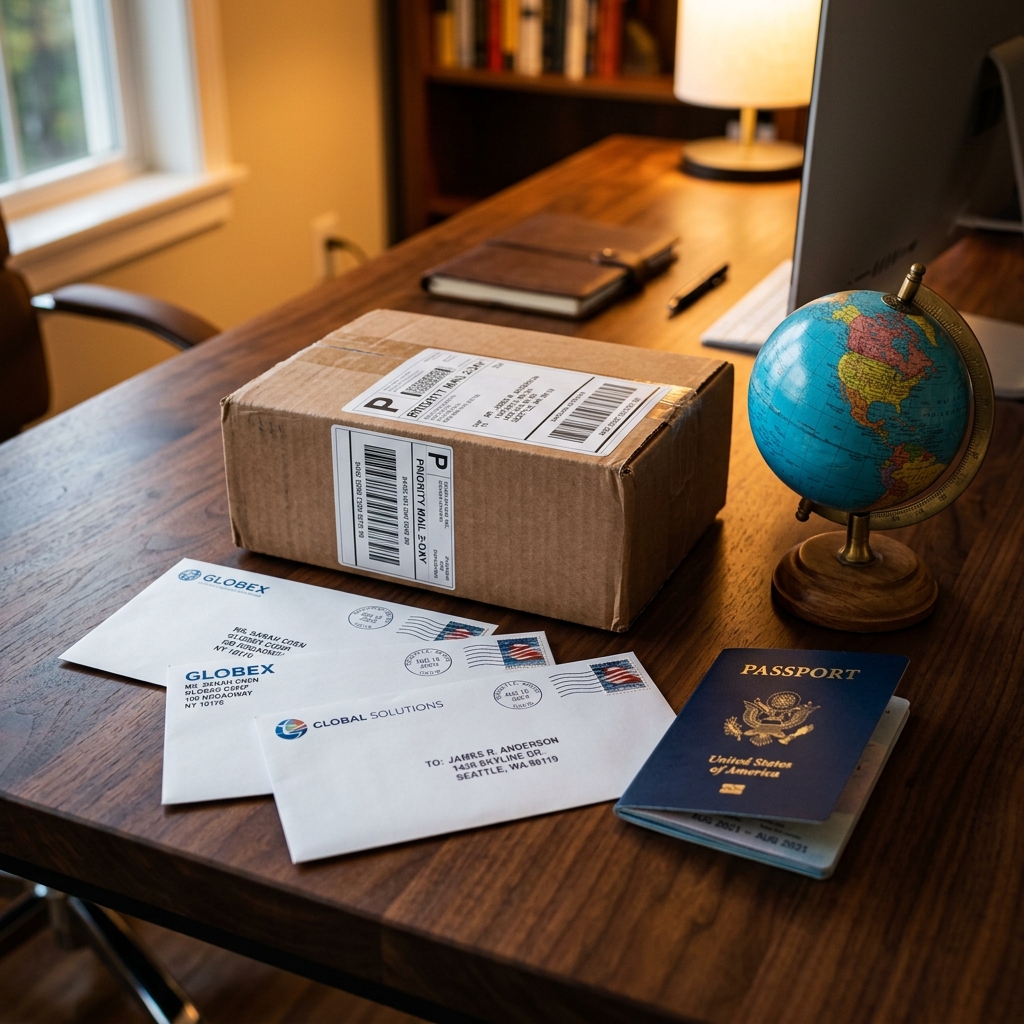
Understanding Virtual Mailboxes vs P.O. Boxes vs Registered Agents
For international founders setting up a US LLC, the best solution is a virtual business address at a physical commercial office from a certified CMRA provider that offers a commercial lease. Traditional P.O. Boxes are banned by US banks and payment processors under federal KYC/AML laws, while registered agent addresses only receive service of process. To pass bank verification, you must present a commercial sublease or utility bill matching your EIN registration. USPS Form 1583 must be notarized via Remote Online Notarization, and physical cards forwarded via secure courier. A virtual address does not automatically trigger state tax nexus.
Establishing a business entity within the United States is a milestone for international entrepreneurs. A critical component of this process is selecting a legal address. Many founders conflate the terms physical address, virtual mailbox, registered agent address, and post office box. Selecting the incorrect address type can halt operations before they begin. This guide analyzes the operational and legal parameters of US business addresses to ensure compliance with federal, state, and banking regulations.
The traditional Post Office Box (P.O. Box) is a service provided by the United States Postal Service (USPS). Located inside post office branches, these boxes offer a secure method for receiving mail. However, for corporate compliance, P.O. Boxes are insufficient. Under federal and state laws, a P.O. Box cannot serve as the registered office of a business entity. State Secretaries of State require a physical street address where legal documents can be delivered. Furthermore, private shipping couriers such as FedEx, United Parcel Service (UPS), and DHL cannot deliver to a USPS P.O. Box. A business relying on a P.O. Box is isolated from major logistical networks and will face immediate rejection when filing entity formation documents.
A Private Mailbox (PMB) is offered by Commercial Mail Receiving Agencies (CMRAs) and commercial logistics providers like the UPS Store. Unlike a P.O. Box, a PMB provides a real street address followed by a unit or box number (e.g., 100 Main Street, Suite 400, PMB 123). This address structure allows the receipt of packages from private couriers. However, PMBs still present regulatory challenges. Financial institutions and payment processors utilize advanced databases to identify PMB addresses. If a business address is flagged as a retail shipping outlet, the business may face compliance checks or account closures.
A Registered Agent is a legal requirement for any US business entity. The agent must maintain a physical office within the state of incorporation and be available during regular business hours to accept service of process (lawsuits, subpoenas, and official government correspondence). While a registered agent address is legally compliant for state registration, it is not designed to serve as a principal place of business. Most registered agents will reject general business correspondence, bank statements, client invoices, and product shipments. Attempting to use a registered agent's address as a primary operating address is a violation of service agreements and fails to satisfy banking verification requirements.
A virtual business address represents a professional solution for non-resident founders. Operated by a CMRA from a commercial office building, a virtual address provides a real street address and a unique suite number. This address is paired with a digital platform that acts as an automated mailroom. When physical mail is received, staff scan the envelopes and upload the images to a secure client dashboard. The client can request a PDF scan of the contents, international forwarding, or secure shredding. A virtual business address meets state registration requirements, supports logistical services, and provides a stable presence for commercial transactions.
The distinction between address types is governed by federal postal regulations and state business codes. In the United States, any entity that receives mail for third parties must register as a CMRA with the USPS. This registration binds the provider to federal regulations concerning mail handling, security, and verification. The databases maintained by the USPS categorize every address in the country. The Coding Accuracy Support System (CASS) and Delivery Point Validation (DPV) databases contain specific flags for CMRAs. When a bank or government agency runs a check on an address, they instantly see if it is classified as a CMRA, a residential home, or a commercial office building. Understanding this database classification is key to navigating bank verification processes. This topic may change based on state, service provider, and current regulations.
Consider an international software developer based in Turkey who registers a Wyoming LLC. If they use a standard P.O. Box, the state filing will be rejected because the Secretary of State requires a physical office. If they use their registered agent's address for their bank application, the bank will flag it as a third-party legal address and demand a commercial lease in the company's name. If they use a UPS Store address, the bank's automated compliance system will identify it as a retail mail drop and suspend the application. Only a premium virtual business address that offers a commercial sublease agreement can successfully navigate these validation filters. This demonstrates the necessity of choosing the correct address infrastructure from day one.
A virtual address provider must offer more than just a street location. The physical facility must have the capacity to handle large volumes of mail and packages. It should be staffed by professionals who understand the legal requirements of mail handling. When selecting a provider, look for companies that have been in business for several years and have established a reputation for reliability. The provider should offer a secure online portal where you can view and manage your mail. The portal should allow you to request mail scans, forward packages, and request document shredding. This operational infrastructure is critical for the smooth running of your US business.
The physical location of your virtual address is also important. Some providers offer addresses in prestigious office buildings in major cities. While these addresses can enhance your company's image, they are often more expensive. For most businesses, an address in a standard commercial office park in a tax-friendly state like Wyoming or Delaware is sufficient. The key is that the address is classified as a commercial building in the USPS database. This ensures that it will pass bank verification checks and meet state registration requirements. Avoid providers that use residential addresses or retail mail drops, as these are frequently flagged by compliance systems.
Using a virtual address involves complying with various legal and regulatory requirements. In addition to filing USPS Form 1583, you must ensure that your use of the address complies with state business codes. Some states require businesses to maintain a physical presence within the state, which can include a physical office or a registered agent. A virtual address can help satisfy these requirements, but you must ensure that the provider is authorized to offer these services. Working with a compliant provider is essential for avoiding legal issues and maintaining your company's good standing. This topic may change based on state, service provider, and current regulations.
Modern compliance verification relies heavily on automated database checks. Financial institutions and government agencies use algorithms to scan business applications and flag inconsistencies. A virtual address provider must use advanced technology to ensure that their addresses are correctly registered and classified. This includes maintaining accurate data in the USPS databases and ensuring that their systems integrate with banking verification platforms. By leveraging technology, providers can help clients bypass automated rejection systems and ensure a smooth setup process. Founders should choose providers that invest in compliance technology to protect their business operations.
| Feature | P.O. Box | Registered Agent | Virtual Business Address |
|---|---|---|---|
| State Registration | Rejected (Requires physical address) | Accepted (For legal service only) | Accepted (Physical commercial street address) |
| US Bank Account Opening | Banned (KYC/AML violation) | Flagged (Rejected for operations) | Accepted (With commercial sublease agreement) |
| Courier Deliveries (UPS/FedEx) | No (USPS mail only) | No (Service of process only) | Yes (All couriers accepted) |
| Digital Mailroom & Scanning | No | No | Yes (Online document access) |
US Banking Verification and KYC Compliance
Federal financial regulations in the United States place a heavy burden of compliance on banking institutions. The primary driver of address verification policies is the USA PATRIOT Act, specifically Section 326, which outlines the Customer Identification Program (CIP) requirements. Under this law, banks must verify the identity and physical location of any individual or entity seeking to open an account. The goal is to prevent the creation of anonymous shell companies that could be used for money laundering, terrorist financing, and tax evasion. As a result, banks have implemented sophisticated automated address validation protocols.
The Financial Crimes Enforcement Network (FinCEN) enforces the Customer Due Diligence (CDD) rule, which requires banks to identify and verify the Ultimate Beneficial Owners (UBOs) of legal entities. A key component of the CDD rule is establishing the company's physical address. The regulation specifies that the bank must obtain a physical street address for the principal place of business. This must be a location where the company conducts its operations or can be contacted. Financial institutions are prohibited from accepting a P.O. Box, a registered agent address, or a mail forwarding address that does not represent a physical operating location. If the address provided is flagged in compliance databases, the bank must request additional documentation to verify the physical presence of the business. This topic may change based on state, service provider, and current regulations.
Banks do not manually inspect every address. Instead, they integrate their application portals with commercial databases and government registries. These databases include the USPS CASS and DPV directories, commercial real estate databases, and credit bureau registries. The DPV system contains specific flags, such as the "CMRA Flag," which indicates whether an address belongs to a commercial mail receiving agency. Another database, the Commercial Mail Receiving Agency database, maintains a list of all registered mail drops. When an application is submitted, the bank's system queries these databases. If the address returns a CMRA flag, the system automatically marks the application for manual review or triggers an immediate rejection. This database verification is automated, making it impossible to bypass through simple modifications of the address formatting.
Payment processors and merchant acquirers such as Stripe, PayPal, and Adyen must comply with similar regulatory frameworks. These processors are classified as money transmitters or work in conjunction with sponsor banks, meaning they are subject to KYC and AML laws. When a merchant signs up for an account, the processor verifies the business address to prevent transaction laundering and credit card fraud. A virtual address that is flagged as a retail mail drop or a shared warehouse will trigger a risk alert. The processor will suspend the merchant account and withhold payouts until the merchant provides proof of a physical business location. In many cases, merchant accounts are terminated permanently if the business cannot prove that it has a physical commercial presence in the US.
To mitigate the risk of address rejection, virtual address providers must secure commercial office space that is registered as a standard commercial building rather than a retail shipping hub. Some high-end providers offer "lease-backed" addresses. These addresses are located in commercial office parks and are registered with the local county tax assessor as commercial office units. By avoiding retail areas and maintaining a clean commercial classification, these offices are less likely to be flagged by automated bank verification systems. However, founders must prepare to provide physical proof of occupancy if the bank's automated compliance system triggers a manual check. This topic may change based on state, service provider, and current regulations.
The consequences of utilizing a non-compliant address are severe. If a bank discovers that a business account was opened using a P.O. Box or an unauthorized mail drop, it will freeze the account immediately. The business will lose access to its capital, pending transactions will be cancelled, and merchant integrations will fail. Regaining access to a frozen account requires providing the bank with an official commercial lease and a utility bill. For international founders, obtaining these documents on short notice is difficult. This can lead to the permanent closure of the banking relationship and the loss of business reputation. Operating with a compliant business address is not merely a legal requirement; it is a critical measure for operational continuity.
Understanding how databases flag addresses is crucial for navigating compliance. The USPS DPV database uses specific codes to classify locations. A code of "Y" indicates that the address is deliverable, while other codes provide detail about the address type. The "CMRA indicator" is a one-character field that is set to "Y" if the address is a CMRA, or "N" if it is not. When a bank's system checks an address, it retrieves this DPV data. If the CMRA indicator is "Y," the system flags the address. Some databases also track the number of businesses registered at a single address. If hundreds of businesses are registered at a single suite, this triggers a high-risk flag, indicating a shell company address. Providers must manage their addresses to avoid these high-risk triggers.
US banking regulations are also influenced by international standards. The Financial Action Task Force (FATF) sets global standards for AML and KYC compliance. The US is a member of the FATF and is committed to implementing its recommendations. These recommendations emphasize the need for transparency and the identification of beneficial owners. Consequently, US regulators continuously update their rules to close loopholes that could be used by illicit actors. This international pressure drives the strict enforcement of address verification rules by US banks. Founders must recognize that these rules are part of a global effort to secure the financial system, making compliance mandatory.
Bank policies regarding address verification are not static. Mergers, acquisitions, and regulatory audits can lead to sudden changes in compliance guidelines. A bank that previously accepted virtual addresses may update its policy and begin flagging them. This can result in unexpected account audits and requests for documentation. To protect their businesses, founders should maintain open lines of communication with their banks and stay informed about policy updates. Using a premium provider that proactively monitors compliance trends and updates its address listings is a valuable strategy for mitigating these risks. This topic may change based on state, service provider, and current regulations.
Digital Mailroom Operations and USPS Form 1583
A professional virtual mailbox provider operates an automated mailroom that functions as the central communications hub for your enterprise. To understand why this infrastructure is compliant and secure, it is necessary to examine the regulatory protocols governing mail handling in the United States, beginning with the United States Postal Service authorization requirements.
Under federal law, specifically Title 39 of the Code of Federal Regulations, a Commercial Mail Receiving Agency (CMRA) cannot legally accept, scan, or handle mail for any client until the client executes USPS Form 1583. This document is a formal application for the delivery of mail through an agent. It binds the agent to follow federal mail handling regulations and authorizes them to receive mail on behalf of the applicant. Without a signed and notarized Form 1583, the CMRA is legally prohibited from processing any mail addressed to your company, and any incoming mail must be returned to the sender. This form must be completed for the business entity and each individual who will receive mail at that address.
USPS Form 1583 requires legal notarization to verify the identity of the applicant. Traditionally, this required visiting a US embassy or consulate, or finding a local notary in the founder's home country who could perform an apostille. Today, this process has been simplified through Remote Online Notarization (RON). Under state laws in jurisdictions such as Virginia, Texas, and Florida, licensed US notaries are authorized to perform notarizations online via secure video link. International founders can connect with a US notary using a webcam and their passport. The notary verifies the applicant's identity, reviews their identification documents, and witnesses the digital signing of Form 1583. This process takes under ten minutes and is accepted by the USPS and virtual address providers.
The USPS maintains strict regulations regarding the identification documents that can be used to execute Form 1583. The applicant must provide two acceptable forms of identification. One of these must contain a photograph. The USPS explicitly lists the documents that are acceptable: valid passport, driver's license, government ID, utility bill, lease agreement, vehicle registration, or corporate ID. Credit cards, birth certificates, and Social Security cards are explicitly rejected by the USPS. If the name or address on the identification documents does not match the name and address on the application, the notarization will be rejected, and the virtual mailbox cannot be activated. This topic may change based on state, service provider, and current regulations.
To execute USPS Form 1583, the applicant must follow a structured process. First, complete the application fields, including CMRA details, applicant name, and home address. Second, prepare clear, high-resolution scans of the two chosen identification documents. Third, connect with a Remote Online Notary service, upload the documents, and complete the verification via video call. The notary will witness the digital signature and apply their seal. Finally, the provider uploads the notarized form to the USPS database, enabling mail delivery services to begin.
Once the virtual mailbox is active, the provider handles mail processing under strict security protocols. When mail is delivered to the commercial facility, the exterior of the envelope is scanned and uploaded to the client portal. The client receives a notification and can request to open and scan the contents, forward the physical mail to their international address, or shred and destroy it. High-quality providers implement security protocols to protect client data, including background-checked mailroom employees, 24/7 video surveillance, and SSL encryption for all digital scans stored in their databases.
CMRAs operate under strict oversight from the USPS and federal law enforcement. If a CMRA fails to verify its clients using Form 1583, it can face civil and criminal penalties, including the loss of its CMRA license. This regulatory pressure explains why providers are meticulous during the onboarding process. They must verify every identity and maintain accurate records for inspection by postal inspectors. For clients, this strict compliance is a benefit. It ensures that the provider is operating legally and that your business address is stable and secure. Working with an uncertified or non-compliant provider exposes your business to the risk of sudden service termination. This topic may change based on state, service provider, and current regulations.
The United States Postal Inspection Service (USPIS) is the law enforcement arm of the USPS. Postal inspectors are federal agents responsible for protecting the mail system from criminal abuse. They perform regular audits of CMRAs to ensure compliance with Form 1583 regulations. Inspectors review client files, check identification records, and verify that mail is being handled securely. If a provider is found to be non-compliant, the USPIS can shut down the facility. This oversight ensures that the CMRA industry maintains high standards of security and compliance, protecting the integrity of your business mail.
In addition to basic scanning and forwarding, premium providers offer advanced mail handling services. These can include check deposit services, where the provider deposits physical checks received in the mail directly into your US bank account. Some providers also offer API integrations, allowing you to automate mail processing workflows. For example, you can set up rules to automatically scan all mail from the IRS and archive it in your cloud storage. These advanced services turn your virtual mailbox into a powerful business tool, streamlining your administrative operations.
Commercial Leases vs Virtual Addresses
As a US business grows, a simple virtual mailbox may not satisfy the requirements of financial institutions, merchant processors, and regulatory agencies. To maintain compliance, founders must evaluate the differences between a virtual mailbox and a commercial office lease. This section provides a cost-benefit analysis and outlines how to use lease agreements to satisfy bank verification requirements.
Renting a physical commercial office in a major US business hub is a significant financial commitment. In states like Delaware, Wyoming, and Florida, the rent for a small commercial office ranges from $1,500 to $5,000 per month. This figure does not include utilities, commercial insurance, internet connectivity, office furniture, and maintenance costs. Furthermore, commercial landlords require a local US guarantor or a significant security deposit (often equivalent to 6 to 12 months of rent) from foreign entities that lack a US credit history. For international startup founders, this represents an inefficient allocation of capital that can deplete early-stage funding. In contrast, a virtual business address costs between $15 and $50 per month, providing a legal business presence at a fraction of the expense. This topic may change based on state, service provider, and current regulations.
Operating a physical office remotely introduces significant logistical challenges. If you are based outside the United States, you must hire local administrative staff to manage the office, retrieve physical mail, handle utilities, and maintain the facility. If a critical document—such as an IRS notice or a legal subpoena—arrives when the office is vacant, the business faces serious consequences. A virtual mailbox automates these administrative tasks entirely. The provider's staff handle the receipt, scanning, and management of mail, routing all communication to a digital dashboard. This system removes the administrative burden and ensures that you never miss a time-sensitive document.
To pass bank KYC checks, a business must show that it has a legal right to occupy its listed address. A commercial sublease or lease agreement is the primary document used to prove this relationship. Premium virtual office providers address this need by offering lease-backed virtual addresses. When you sign up, you receive a formal, signed commercial sublease agreement between your business entity and the office provider. This sublease grants your company the legal right to utilize the commercial office building and specifies the suite number. Because this is a binding contract, banks accept it as proof of address, bypassing the need for utility bills. This sublease agreement is a critical tool for international founders who must open US bank accounts remotely.
The standard requirement for bank verification is a utility bill (electricity, water, gas, or wired internet) issued in the company's name at the business address. While simple for local businesses, this is difficult for virtual address users. Most virtual office providers lease a single building and partition it into suites. The utility bills for the building are issued in the name of the main provider rather than the individual businesses. To solve this, premium providers offer utility bill assistance. They work with local service providers to issue utility statements or service agreements (such as a dedicated business phone line or private internet connection) under the client's business name and suite. Providing a utility statement alongside a commercial sublease satisfies the bank compliance requirements, ensuring that the account application is approved. This topic may change based on state, service provider, and current regulations.
A common error that leads to bank rejection is inconsistency across corporate documents. The address listed on the Articles of Organization, the EIN confirmation letter (Form CP 575), the commercial lease, and the bank application must match exactly. If the state filing lists "Suite 100" but the bank application lists "Unit 100," or if the EIN letter lists a registered agent address instead of the virtual address, the bank's automated compliance system will flag the mismatch. This will trigger a compliance review and delay the account opening. Founders must ensure that their business address is formatted consistently across all federal, state, and financial filings.
The drafting of a commercial lease agreement requires attention to specific legal clauses. The agreement must clearly define the parties, the leased premises, the term of the lease, and the rent. It should also include clauses regarding the use of the premises, maintenance responsibilities, and insurance requirements. For virtual address users, the lease must explicitly state that the tenant has the right to use the address for business registration and banking purposes. A poorly drafted lease that lacks these clauses may be rejected by bank compliance teams. Premium providers ensure that their lease templates are drafted to meet banking and regulatory standards.
Subleasing is a common practice in the virtual office industry. The primary provider leases a large commercial space from the building owner and then subleases individual suites or desks to clients. This arrangement must be authorized by the primary lease between the provider and the landlord. If the landlord has not authorized subleasing, the sublease agreement with the client may be invalid. When choosing a provider, confirm that they have the legal authority to sublease the space. A valid commercial sublease is essential for satisfying bank KYC requirements and protecting your business presence. This topic may change based on state, service provider, and current regulations.
Co-working spaces offer another alternative to traditional commercial leases. These spaces provide shared office environments with flexible leasing terms. Many co-working providers offer virtual office packages that include a business address and mail handling services. While co-working spaces can provide a compliant address, you must ensure that the address is classified as commercial and that the provider can supply a lease agreement. Some co-working addresses are flagged as shared spaces, which can trigger additional verification requests from banks. Research the co-working provider's compliance history before signing an agreement.
Selecting a Premium Provider and State Tax Nexus
Operating a US business from abroad requires a reliable logistical pipeline for forwarding physical assets, such as bank debit cards, credit cards, checkbooks, and commercial documents. It also requires an understanding of state tax regulations, as maintaining a business address can have tax implications. This section explains the logistics of international forwarding and the rules governing state tax nexus.
When sensitive physical items—such as corporate debit cards or checkbooks—are delivered to a virtual address, they cannot be scanned. Instead, they must be shipped to the founder's home country. This requires a secure, tracked shipping process. Virtual address providers package these items and ship them using international couriers like DHL, FedEx, UPS, or USPS Priority Mail Express. These carriers offer end-to-end tracking and signature-required delivery options. This ensures that valuable items do not get lost in transit. Providers also consolidate multiple mail items into a single shipment to reduce international shipping costs for the client.
Every international shipment requires a customs declaration. This declaration lists the contents, value, and Harmonized System (HS) code of the items. For bank cards, the declaration must indicate that the package contains plastic cards or smart cards (HS code 8523.51 or 3924.90). If the declaration is incorrect or if the value is misstated, the package may be delayed by customs officials or returned to the sender. Premium virtual address providers handle this customs documentation, ensuring that the declarations are accurate and comply with international shipping regulations. The client is responsible for paying any import duties or local taxes that apply when the package arrives. This topic may change based on state, service provider, and current regulations.
A major concern for international founders is whether maintaining a US business address triggers state tax nexus. Tax nexus is the level of connection that allows a state to impose tax obligations on a business. It is divided into physical nexus, established by physical office space, inventory, or staff, and economic nexus, triggered by sales thresholds (Wayfair decision). Understanding these rules is essential for managing state tax obligations and avoiding compliance penalties.
Different US states have varying tax laws that affect virtual address users. Delaware does not impose corporate tax on companies not conducting business there, but requires annual franchise tax. Wyoming has no corporate tax, income tax, or franchise tax. Florida has no personal income tax but taxes C-corporations. New York has complex tax rules where a NY business address can trigger NY state tax filings. Founders must research the tax laws of their chosen state. This topic may change based on state, service provider, and current regulations.
Tax laws, banking compliance policies, and postal regulations are subject to frequent changes. The information in this guide is provided for educational purposes and does not constitute legal, financial, or tax advice. Business owners must consult with qualified legal counsel, certified public accountants (CPAs), and tax advisors to ensure that their business operations comply with current local, state, and federal laws. This topic may change based on state, service provider, and current regulations.
Sales tax compliance is a complex issue for e-commerce sellers. Once economic nexus is triggered in a state, the business must register for a sales tax permit, collect sales tax on transactions, and file regular sales tax returns. Using a virtual address in a tax-friendly state like Wyoming does not exempt you from sales tax obligations in other states where you meet economic nexus thresholds. Founders should use sales tax automation software to track their sales and manage compliance across multiple states. This minimizes the risk of audits and penalties.
State income taxes can also impact your business profitability. States like California and New York have high corporate income tax rates, while states like Texas and Wyoming have none. If your business address is located in a high-tax state, you may be subject to filing requirements and tax liabilities. This is true even if your physical operations are located outside the US. By selecting a virtual address in a state with no income tax, you can optimize your tax structure and reduce your overall tax burden. Consult with a CPA to determine the best state for your business. This topic may change based on state, service provider, and current regulations.
To maintain your US business in good standing, you must comply with annual filing requirements. Most states require businesses to file an annual report and pay a fee. The filing deadline and fee amount vary by state. Failure to file can result in penalties, interest, and the dissolution of your business. Your virtual address provider can assist by receiving state notifications and forwarding them to you. Keeping your business in good standing is essential for maintaining your banking relationships and commercial credibility.
To understand the depth of USPS Form 1583 requirements, one must look at the history of postal fraud prevention in the United States. Over the last three decades, federal authorities have continuously updated CMRA regulations to address emerging compliance challenges. CMRAs are now integrated into federal law enforcement databases, allowing immediate lookup of mailbox owners by postal inspectors. This tight integration ensures that businesses using virtual addresses are held to the same compliance standards as physical tenants.
Furthermore, remote online notarization (RON) has evolved from a state-level experiment into a nationally recognized standard. Following the passage of various state-level RON laws, the interstate recognition of electronic notarizations became common practice. Under the Full Faith and Credit Clause of the United States Constitution, a notarization performed legally under the laws of one state must be recognized by other states and federal agencies. This constitutional backing gives international founders confidence that their online notarizations are legally valid across all US jurisdictions.
When executing the secondary identification requirements for Form 1583, founders often encounter hurdles due to differences in international documentation. For instance, utility bills in some countries may not list the founder's name or may be issued in a local language. In these cases, virtual address providers work with international verification partners to translate and validate the documents. It is crucial to translate documents using certified translation services, as banks and postal authorities will reject documents that are not in English or accompanied by a certified translation.
The logistics of forwarding physical credit cards require careful planning to prevent intercept fraud. Credit card issuers typically mail cards in unmarked envelopes to minimize the risk of theft during transit. When these envelopes arrive at a virtual address, the provider's automated system cataloges them based on weight and dimensions. To ensure security, founders should request the provider to ship the card in its original, sealed envelope inside a secure courier pack. This double-packaging method protects the card's smart chip and magnetic stripe from tampering. This topic may change based on state, service provider, and current regulations.
The dynamic nature of international trade requires businesses to maintain a flexible logistics strategy. In addition to forwarding bank cards, founders must often handle physical product samples, marketing materials, and supplier contracts. A premium virtual address provider offers inventory management and package consolidation services to streamline these processes. By grouping multiple packages into a single international shipment, businesses can save up to seventy percent on shipping fees. This economic advantage is crucial for early-stage startups managing tight budgets. This topic may change based on state, service provider, and current regulations.
Furthermore, the legal landscape surrounding Remote Online Notarization continues to evolve. While the SECURE Notarization Act has been introduced at the federal level to establish nationwide standards, state laws still govern the immediate execution of RON. Proactive founders should verify that their online notary is commissioned in a state that has permanent RON legislation, such as Texas or Florida. This guarantees that the notarized Form 1583 will be accepted by the USPS and federal agencies without additional legal challenges. Keeping abreast of these legislative developments is a core part of corporate compliance.
Finally, the relationship between physical presence and tax nexus remains a critical point of analysis. States are increasingly aggressive in enforcing economic nexus thresholds following the Supreme Court's Wayfair decision. While a virtual office address alone does not establish physical nexus, conducting sales, holding inventory in third-party warehouses, or employing remote workers in a state will trigger tax liabilities. Corporate officers must implement robust sales tax tracking software to monitor transaction volumes in real-time. This prevents unexpected audit notices and ensures that the enterprise remains in good standing across all jurisdictions.
The dynamic nature of international trade requires businesses to maintain a flexible logistics strategy. In addition to forwarding bank cards, founders must often handle physical product samples, marketing materials, and supplier contracts. A premium virtual address provider offers inventory management and package consolidation services to streamline these processes. By grouping multiple packages into a single international shipment, businesses can save up to seventy percent on shipping fees. This economic advantage is crucial for early-stage startups managing tight budgets. This topic may change based on state, service provider, and current regulations.
Furthermore, the legal landscape surrounding Remote Online Notarization continues to evolve. While the SECURE Notarization Act has been introduced at the federal level to establish nationwide standards, state laws still govern the immediate execution of RON. Proactive founders should verify that their online notary is commissioned in a state that has permanent RON legislation, such as Texas or Florida. This guarantees that the notarized Form 1583 will be accepted by the USPS and federal agencies without additional legal challenges. Keeping abreast of these legislative developments is a core part of corporate compliance.
Finally, the relationship between physical presence and tax nexus remains a critical point of analysis. States are increasingly aggressive in enforcing economic nexus thresholds following the Supreme Court's Wayfair decision. While a virtual office address alone does not establish physical nexus, conducting sales, holding inventory in third-party warehouses, or employing remote workers in a state will trigger tax liabilities. Corporate officers must implement robust sales tax tracking software to monitor transaction volumes in real-time. This prevents unexpected audit notices and ensures that the enterprise remains in good standing across all jurisdictions.
Frequently Asked Questions and Answers
What is the difference between a Registered Agent address and a Virtual Business Address? ▼
A Registered Agent address is a legal requirement used solely to receive service of process and official state government correspondence. It is not an operating address. You cannot use it to receive general business mail, client packages, or bank statements, and banks will reject it as a primary business location. In contrast, a Virtual Business Address is a real street address at a commercial facility that acts as your company's physical mailing location. It is paired with a digital mailroom platform that allows you to manage all types of mail, packages, and corporate communications from anywhere in the world.
Why do US banks reject P.O. Box addresses for business accounts? ▼
US banks reject P.O. Boxes to comply with federal Know Your Customer (KYC) and Anti-Money Laundering (AML) regulations under the USA PATRIOT Act. These laws require financial institutions to verify the physical street address of the business and its owners to prevent the creation of anonymous shell companies. Automated verification databases categorise P.O. Boxes and retail mail drops as non-physical addresses. If your business address is flagged as a P.O. Box, the bank's automated compliance system will trigger a verification failure and reject the application.
How can I get a commercial lease agreement for my virtual business address? ▼
Premium virtual business address providers offer lease-backed address services. When you sign up for these premium packages, the provider issues a formal commercial sublease agreement in your company's name. This sublease grants your company the legal right to occupy the commercial office space. This document is signed by both parties and serves as a valid commercial lease, which you can submit to US banks and payment processors to satisfy their address proof requirements.
What is USPS Form 1583 and how do I notarize it online? ▼
USPS Form 1583 is a federal document required by the United States Postal Service that authorizes a Commercial Mail Receiving Agency (CMRA) to receive and handle mail on your behalf. To notarize it online, you can use a Remote Online Notarization (RON) platform. You will upload the completed form and two forms of acceptable identification (such as your passport and a utility bill). You will then connect with a licensed US notary public via video call. The notary will verify your identity, witness your digital signature, and apply their notary seal to the document.
What forms of identification are accepted for USPS Form 1583? ▼
The USPS requires two forms of identification, and one must contain a photograph. Acceptable primary photo IDs include a valid passport, a government driver's license, or a state ID card. Acceptable secondary IDs must show your home address and include a current lease agreement, a home utility bill, a voter registration card, or a vehicle registration card. Credit cards, birth certificates, and Social Security cards are explicitly rejected by the USPS as valid forms of identification.
Does having a virtual address in a state create a tax nexus? ▼
Maintaining a virtual business address or a registered agent address does not automatically establish a physical tax nexus in that state, provided your company does not have physical offices, inventory, or employees located there. However, you can still trigger an economic tax nexus if your sales in a state exceed certain economic thresholds (such as $100,000 in sales or 200 transactions). You must consult with a certified public accountant (CPA) to evaluate your specific tax obligations, as this topic may change based on state, service provider, and current regulations.
Can I receive bank debit cards and checkbooks at my virtual address? ▼
Yes. A virtual business address is located at a commercial facility that can receive mail from all major couriers (USPS, FedEx, UPS, DHL). When physical bank cards or checkbooks arrive, the provider scans the package exterior and notifies you. Because these physical assets cannot be scanned, you must request international forwarding. The provider will then ship the items to your international address using a tracked courier service. This ensures the safe delivery of your financial cards.
How do I handle bank KYC checks if I do not have a US utility bill? ▼
If you do not have a US utility bill, you can submit a commercial sublease agreement provided by your virtual address service. This sublease shows that your business has a legal right to occupy the commercial space. Additionally, you can request your provider to set up a dedicated utility service (such as a business phone line or internet connection) in your company's name. This will generate a monthly utility statement that you can submit to the bank compliance team as proof of address. This topic may change based on state, service provider, and current regulations.
How do customs declarations work for internationally forwarded corporate bank cards? ▼
When forwarding physical bank cards or smart cards internationally, the package must include an accurate customs declaration. The sender must list the correct Harmonized System (HS) code, which is usually 8523.51 for smart cards or 3924.90 for general plastic items. The declared value should reflect the nominal replacement cost of the plastic card (typically $5 to $10) rather than the funds in the account. An incorrect declaration can lead to customs delays, package confiscation, or import penalties at the destination country. This topic may change based on state, service provider, and current regulations.
Why do payment gateways like Stripe and PayPal audit virtual business addresses? ▼
Stripe, PayPal, and other payment gateways are subject to strict financial regulations, including anti-money laundering (AML) and customer identification program (CIP) rules. They must ensure that the merchant is operating a legitimate business and is not using a shell company address. Automated risk algorithms scan merchant profiles and flag shared addresses or retail mail drops. When flagged, the processor will request a valid commercial sublease agreement or a utility bill to verify physical presence. Failure to provide this proof will result in account suspension.
Is a US Social Security Number (SSN) required for Remote Online Notarization of Form 1583? ▼
No. A US Social Security Number (SSN) or Individual Taxpayer Identification Number (ITIN) is not required for a non-resident founder to complete Remote Online Notarization (RON). Licensed online notaries can verify the identity of international citizens using a valid foreign passport and biometric facial recognition technology. The video call is recorded and archived as required by state notary laws, providing a secure and legally compliant method for executing USPS Form 1583 without US tax IDs.
How does the USPS DPV database categorize a virtual office address? ▼
The USPS Delivery Point Validation (DPV) database categorizes addresses using specific indicators. A commercial address is flagged as a Commercial Mail Receiving Agency (CMRA) if it belongs to a mail forwarding service. Banks and financial institutions query the DPV database during the KYC process. Premium virtual offices are located in commercial business parks and are registered as standard suite addresses rather than retail shipping outlets, allowing them to pass automated database checks more successfully. This topic may change based on state, service provider, and current regulations.
How do customs declarations work for internationally forwarded corporate bank cards? ▼
When forwarding physical bank cards or smart cards internationally, the package must include an accurate customs declaration. The sender must list the correct Harmonized System (HS) code, which is usually 8523.51 for smart cards or 3924.90 for general plastic items. The declared value should reflect the nominal replacement cost of the plastic card (typically $5 to $10) rather than the funds in the account. An incorrect declaration can lead to customs delays, package confiscation, or import penalties at the destination country. This topic may change based on state, service provider, and current regulations.
Why do payment gateways like Stripe and PayPal audit virtual business addresses? ▼
Stripe, PayPal, and other payment gateways are subject to strict financial regulations, including anti-money laundering (AML) and customer identification program (CIP) rules. They must ensure that the merchant is operating a legitimate business and is not using a shell company address. Automated risk algorithms scan merchant profiles and flag shared addresses or retail mail drops. When flagged, the processor will request a valid commercial sublease agreement or a utility bill to verify physical presence. Failure to provide this proof will result in account suspension.
Is a US Social Security Number (SSN) required for Remote Online Notarization of Form 1583? ▼
No. A US Social Security Number (SSN) or Individual Taxpayer Identification Number (ITIN) is not required for a non-resident founder to complete Remote Online Notarization (RON). Licensed online notaries can verify the identity of international citizens using a valid foreign passport and biometric facial recognition technology. The video call is recorded and archived as required by state notary laws, providing a secure and legally compliant method for executing USPS Form 1583 without US tax IDs.
How does the USPS DPV database categorize a virtual office address? ▼
The USPS Delivery Point Validation (DPV) database categorizes addresses using specific indicators. A commercial address is flagged as a Commercial Mail Receiving Agency (CMRA) if it belongs to a mail forwarding service. Banks and financial institutions query the DPV database during the KYC process. Premium virtual offices are located in commercial business parks and are registered as standard suite addresses rather than retail shipping outlets, allowing them to pass automated database checks more successfully. This topic may change based on state, service provider, and current regulations.