Introduction & The Role of a US Business Address
For remote entrepreneurs, digital nomads, and international business owners setting up a corporate entity in the United States, obtaining a physical address is one of the first major structural challenges. To form a Limited Liability Company (LLC) or a Corporation, state laws require you to list a physical street address for your business office. Additionally, federal banking regulations mandate that financial institutions verify a physical operating location for your business before opening commercial accounts.
For non-US residents or remote domestic business owners, leasing physical office spaces in states like Delaware, Wyoming, or Florida is economically unfeasible, costing thousands of dollars per month in rent, utilities, and maintenance. Fortunately, the business services market has evolved to offer a highly efficient, legal alternative: a virtual business address.
A virtual business address (or virtual office address) is a real physical commercial street address that you can rent remotely. It acts as your official corporate headquarters on public records, receives your physical mail, digitizes it through secure scanning, and forwards it to you anywhere in the world. However, not all virtual addresses are accepted by banks and state regulators, and choosing the wrong service can lead to immediate compliance failures.
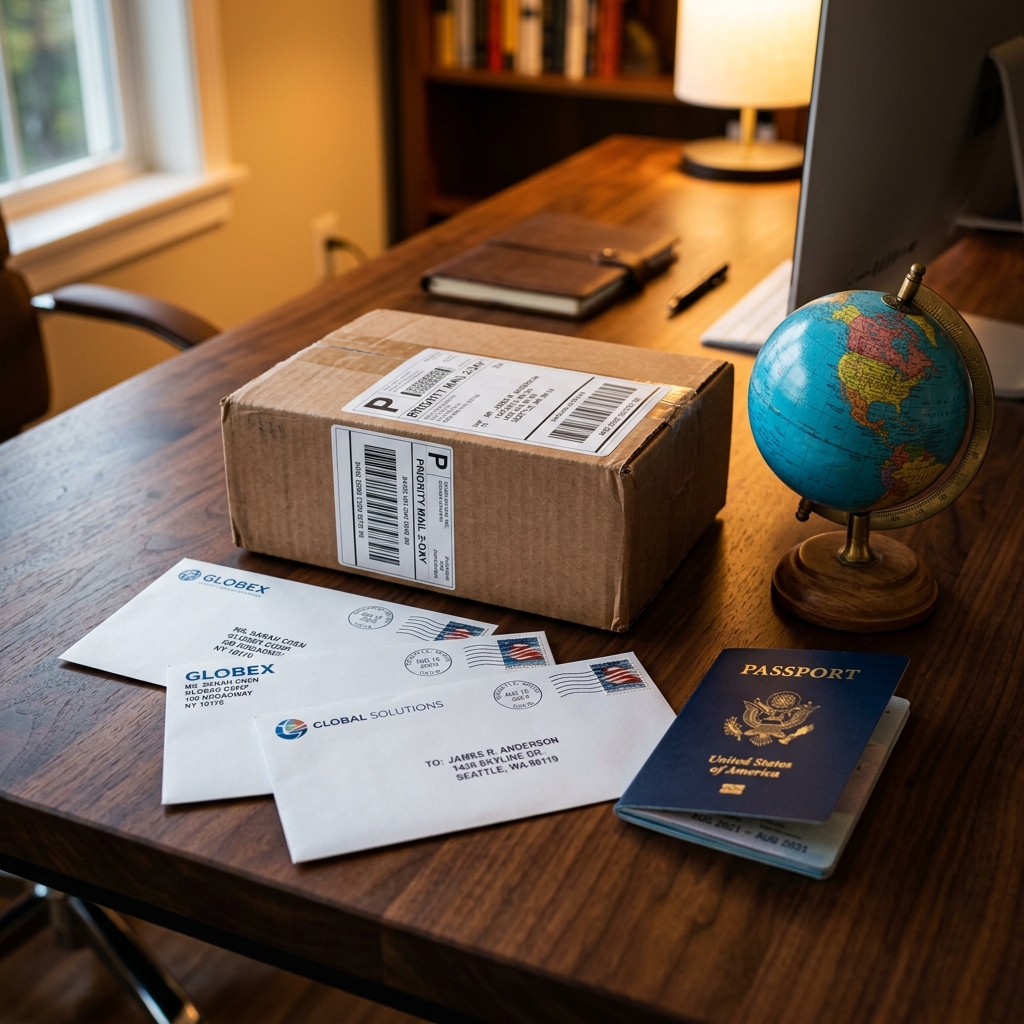 A virtual address provides a real physical commercial location in the US to receive and digitize corporate mail.
Why Banks and Stripe Reject P.O. Boxes
A common error made by new business owners is attempting to use a standard Post Office Box (P.O. Box), a UPS Store address, or a virtual mailbox provider designed strictly for consumer mail forwarding. While these services are useful for personal mail, they are routinely flagged and rejected by corporate compliance systems.
Federal KYC and AML Regulations
Under the federal USA PATRIOT Act, financial institutions are legally required to establish a Customer Identification Program (CIP). As part of this program, US banks must collect and verify the physical street address of the principal place of business for any corporate entity opening an account. The regulations explicitly state that a P.O. Box or a mail drop location cannot serve as the business address.
Automated Registry Screening
Major US banks (such as Mercury, Wise, Chase, and Bank of America) alongside merchant payment processors like Stripe and PayPal run address entries through automated databases (such as the USPS Coding Accuracy Support System). If the system flags the address as a P.O. Box, a mail forwarding facility, or a UPS store, the application is automatically rejected, or the account is suspended pending proof of a physical lease agreement or utility bill. A premium virtual business address provides a verified commercial location that appears in databases as a real office suite, bypassing these automatic rejections.
Choosing the Right Virtual Address Provider
When selecting a virtual business address provider, it is critical to evaluate their services against strict compliance standards. A failure in your address provider's operations can disrupt your banking access and payment processing. Look for the following essential criteria:
Verified Commercial Office Buildings
Ensure the provider operates out of a real, physical commercial office building, not a residential home, a retail shopping center, or a shipping depot. The address should be formatted cleanly with an office or suite number (e.g., 100 Main St, Suite 500) rather than a private mailbox number (PMB), which raises compliance flags.
Immediate Mail Digitization & Secure Portal Access
Your provider must offer secure mail scanning. When official mail (such as IRS letters, bank cards, or state notices) arrives, the provider should open, scan, and upload the contents to a secure client portal within 24 hours. Digital security is paramount; the scanning facility should follow strict privacy protocols to protect your corporate financial information.
Physical Mail and Debit Card Forwarding
While digital scans are sufficient for letters, you will require physical delivery for items like corporate debit cards, checkbooks, or original state certificates. The provider must offer international shipping options (via DHL, FedEx, or USPS) to forward these physical items to your home country securely.
Lease Agreements & Utility Bill Services
To open accounts at traditional retail banks or satisfy advanced verification requests on Stripe, you may be asked to present a formal lease agreement or a utility bill matching your business address. Premium virtual address providers offer "utility verification" or "dedicated desk leases" that provide these legal documents to satisfy bank compliance departments.
Physical Leases vs. Virtual Addresses Comparison
To help you understand the operational and financial trade-offs, the following table compares a traditional physical office lease against a professional virtual business address:
| Comparison Criteria | Traditional Physical Office Lease | Professional Virtual Business Address |
|---|---|---|
| Annual Costs | High ($12,000 to $60,000+ per year in rent and utilities) | Low ($150 to $450 per year flat rate) |
| Setup Timeline | Slow (1 to 3 months for negotiations, leases, and fit-outs) | Instant (Setup and active within 24 to 48 hours) |
| Mail Management | Manual (Requires physical presence to collect and sort mail) | Automated (Saves time via digital scans and online portal) |
| Geographical Flexibility | Fixed (You must physically operate from that location) | Global (Manage your US business from any country) |
| Lease Commitments | Long-term (Typically requires a 1 to 5-year commercial lease) | Flexible (Month-to-month or annual agreements) |
| Bank and Stripe Compliance | 100% Compliant | Highly Compliant (If using verified commercial suite address) |
For remote startups, digital nomads, and e-commerce sellers, a virtual business address provides the necessary compliance tools at a fraction of the cost of a physical lease.
Step-by-Step Address Setup and Integration Guide
Setting up your virtual business address is a structured process that requires legal verification to comply with United States Postal Service (USPS) regulations. Follow these steps to ensure a compliant setup:
Purchase Your Virtual Address Plan
Select your desired state of formation (e.g., Wyoming, Delaware, or Florida) and purchase a virtual address plan. Ensure the plan includes mail scanning, storage, and forwarding options.
Submit Government Identification Documents
Under federal regulations, the address provider must verify your identity before redirecting your mail. You must present two forms of government-issued identification. One must be a photo ID (such as a valid passport or driver's license), and the second must show your name and address (such as a utility bill, bank statement, or voter registration card).
Update Your State and Federal Registries
Once your address is active and verified, use it on your Articles of Organization, your registered agent records, your IRS EIN application, and your corporate bank accounts. Ensure the address format is used identically across all platforms to prevent compliance mismatches.
Navigating USPS Form 1583 and Remote Notarization
The single most critical step in activating a US virtual business address is completing USPS Form 1583 (Application for Delivery of Mail Through Agent). Under federal law, your address provider acts as a Commercial Mail Receiving Agency (CMRA) and is legally prohibited from processing or opening your mail without this form on file.
Form 1583 authorizes the CMRA to act as your agent for mail delivery. The form requires your legal details, the rented virtual address, and signatures from both you and the CMRA representative.
The Notarization Mandate
To prevent identity theft and mail fraud, the USPS requires that Form 1583 be formally notarized. As an international founder, you do not need to visit a US embassy or travel to the US. You can complete the notarization online through Remote Online Notarization (RON) platforms like Notarize.com or NotaryCam. During a short 5-minute video call with a licensed US notary, you will present your passport and sign the document digitally. Once signed, the notarized Form 1583 is automatically submitted to your address provider, activating your mail digitization portal.
Frequently Asked Questions & Expert Guidance
What is a virtual business address? ▼
A virtual business address is a real physical street address at a commercial office building that you rent to act as your official business address. The provider receives your physical mail, scans it, and uploads the digital copies to a secure online portal for you to read remotely.
Why do US banks and Stripe reject P.O. Box addresses? ▼
US banking regulations (specifically the USA PATRIOT Act) mandate that banks verify a physical operating address for any corporate account. P.O. Boxes, UPS stores, and simple mail drops are flagged as shell locations by bank compliance databases and rejected automatically.
What is USPS Form 1583 and why is it mandatory? ▼
USPS Form 1583 is a federal document that authorizes a commercial mail receiving agency (CMRA) to receive and process mail on behalf of your business. Under US postal laws, a provider cannot legally accept or open your mail without a notarized copy of this form on file.
How do I notarize Form 1583 if I live outside the United States? ▼
You can notarize Form 1583 remotely through Remote Online Notarization (RON) platforms. You will upload your ID documents and join a secure 5-minute video call with a licensed US notary who will verify your identity and witness your digital signature.
What documents are required to activate a virtual address? ▼
You must present two forms of government-issued identification. The primary ID must be a photo document, such as a valid passport or driver's license. The secondary ID must verify your address, such as a recent utility bill, bank statement, or home country registration card.
Can I receive debit cards and physical packages at my virtual address? ▼
Yes. A professional virtual address provider can accept physical mail, bank checkbooks, and debit cards. They will notify you of the delivery and, upon request, ship the physical items to your international residential address using carriers like DHL or FedEx.
Is a virtual address the same as a registered agent address? ▼
No, they are legally distinct. A registered agent address is strictly for receiving service of process (lawsuits) and official state notices during business hours. A virtual business address is for general business mail, opening bank accounts, and listing on your website or public records.
Can I use my virtual address on my IRS EIN application? ▼
Yes. You can use your virtual address as the physical location of your company on Form SS-4 when applying for your Employer Identification Number (EIN). Ensure the address is written exactly as formatted by your provider to prevent processing delays.