Introduction & Comparative Overview
For international entrepreneurs planning to incorporate a business inside the United States, choosing the correct state of formation is one of the most critical structural decisions. Over 90% of non-resident founders choose between two primary states: Delaware and Wyoming. Both states have established themselves as corporate hubs, offering foreign owners access to the US banking system and merchant processors without state-level personal income tax. However, Delaware and Wyoming target entirely different business profiles and operational scales.
Wyoming has designed its corporate ecosystem to support small to medium-sized business owners, individual freelancers, e-commerce sellers, and family offices. It focuses on affordability, ease of compliance, and robust owner anonymity. Its primary goal is keeping operational maintenance costs as low as possible.
Delaware, conversely, is the corporate capital of the United States. It is designed specifically for high-growth startups, venture-backed companies, and businesses planning to raise public capital. Delaware's corporate appeal lies in its highly sophisticated legal system, investor familiarity, and template-based corporate conversion procedures.
Choosing incorrectly can lock your business into thousands of dollars in unnecessary annual fees, or force you into complex state conversions later. Understanding the core structural differences between these two corporate titans is essential to safeguard your startup's financial margins.
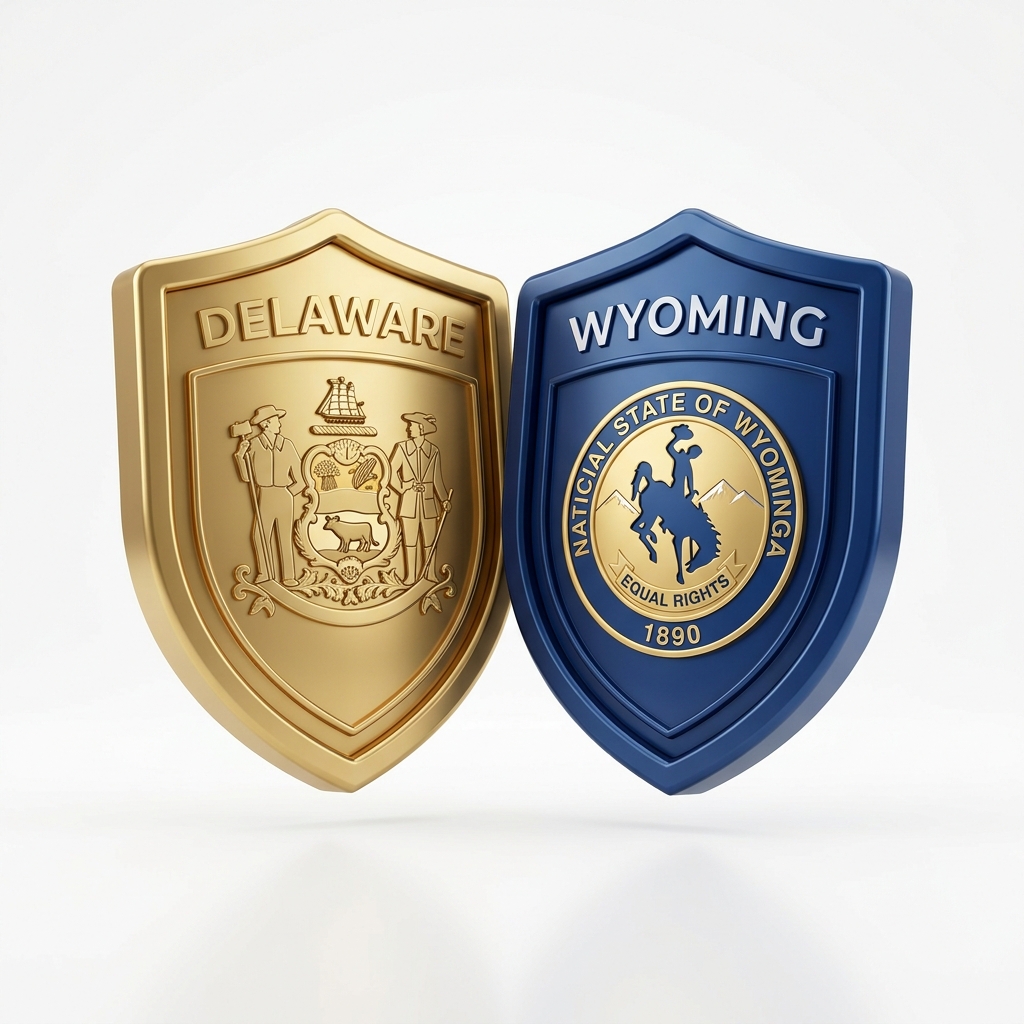 Wyoming and Delaware are the two leading states for remote non-resident US LLC formation.
State Filing Fees & Mandatory Maintenance Costs
For bootstrapped startups and cash-flow-conscious founders, ongoing maintenance costs represent a critical metric. When comparing the annual compliance expenses between Delaware and Wyoming, a massive financial gap quickly becomes apparent:
Wyoming Compliance Fees
Wyoming is highly cost-effective. The state charges a one-time Secretary of State filing fee of $102 to register an LLC. Every year thereafter, Wyoming mandates an annual report filing fee of exactly $62 (which is asset-based, meaning it remains $62 unless you hold more than $250,000 in physical assets located inside Wyoming state borders). The deadline is always on the first day of your company's anniversary formation month.
Delaware Compliance Fees
Delaware is significantly more expensive. The initial filing fee to register an LLC is $90. However, Delaware imposes a flat annual Franchise Tax of $300 on all LLCs, regardless of company revenue, assets, or trading activity. If you register a C-Corporation, the franchise tax is computed using the authorized shares method, which can quickly spiral into thousands of dollars if not set up correctly. The Delaware LLC Franchise Tax deadline is strictly June 1st of every calendar year. Failing to submit it on time triggers a mandatory $200 penalty plus 1.5% monthly interest.
If you factor in professional registered agent fees ($39 to $150 per year), maintaining a Delaware LLC costs roughly $350 to $450 annually, whereas a Wyoming LLC can be maintained for less than $150 per year. For international founders operating small-scale remote entities, Wyoming yields significant yearly savings.
Privacy Protections & Owner Anonymity Rules
Maintaining owner privacy is an important objective for international founders seeking to prevent public disclosure of their personal assets and prevent third-party lookup audits. Both Wyoming and Delaware offer robust asset protection, but their public directories operate differently:
Wyoming Anonymous LLCs
Wyoming is the pioneer of LLC privacy in the US. When you file a Wyoming LLC, the state does not require the names, email addresses, or physical addresses of the LLC's members or managers to be listed in the Articles of Organization. Only the details of your Registered Agent are displayed on the public registry. This allows you to run a fully legal, anonymous business entity where your personal name is completely hidden from public search engines.
Delaware Anonymous LLCs
Delaware offers a similar level of corporate privacy. The state does not display member or manager information in its public filings. The Delaware Certificate of Formation only lists the name of the LLC and the address of its registered agent. However, Delaware's state database lookup fees are slightly higher, making it less accessible for casual web scrapers to search company metadata.
Note that both states comply with federal transparency laws. Under the new Corporate Transparency Act, you must still report the Beneficial Ownership Information (BOI) of all owners holding 25% or more equity directly to FinCEN (a bureau of the US Treasury). However, this data is held securely by the government and is not accessible to the public or competitors.
Legal Systems & Corporate Case Law History
For larger enterprises and companies operating in complex industries, the predictability of a state's legal framework is highly valuable. This is the domain where Delaware surpasses all other US states:
Delaware Court of Chancery
Delaware features a specialized judicial body known as the Court of Chancery. Unlike standard state courts, the Court of Chancery handles corporate and business disputes exclusively. Cases are decided by expert judges (known as Chancellors) who specialize in corporate law, rather than juries who may not understand complex business structures. Over 120 years of corporate litigation history has created a vast body of legal precedents, making the outcome of business disputes in Delaware highly predictable.
Wyoming State Courts
Wyoming uses standard state-level courts to settle business disputes. While Wyoming's legal system is reliable, its judges are generalists who handle everything from family disputes to criminal cases. Wyoming has a far smaller body of corporate case law compared to Delaware, which means business litigation outcomes carry higher uncertainty and can take significantly longer to resolve.
Wyoming and Delaware shields represent liability protection for foreign business owners.
Investor Preferences & Venture Capital Suitability
If your business plans to raise external funding, secure angel investments, or pitch to venture capital (VC) firms, the choice between Wyoming and Delaware is simple:
The Venture Capital Default
Venture capital firms and institutional investors almost exclusively mandate that their portfolio companies be registered as Delaware C-Corporations. Investors are intimately familiar with Delaware's corporate laws, filing templates, and stock option structures. Utilizing a Delaware entity reduces legal friction, speeds up due diligence, and allows you to issue stock options to employees under standardized agreements.
Wyoming VC Rejections
VCs rarely invest in Wyoming LLCs or Corporations. If you pitch to an investor with a Wyoming entity, they will almost certainly require you to perform a statutory conversion or merge your Wyoming entity into a newly formed Delaware C-Corp before they write a check. This conversion process requires professional legal help and can cost between $1,500 and $3,000 in filing and attorney fees. Therefore, if raising VC money is your target, save yourself the friction and register in Delaware from day one.
Structured Comparison & Scorecard Summary
To synthesize the key differences between these two states, we have structured a scorecard comparison outlining setup costs, maintenance, privacy, and investor compatibility:
| Filing Criteria | Wyoming LLC | Delaware LLC |
|---|---|---|
| State SOS Filing Fee | $102 (One-time) | $90 (One-time) |
| Annual State Fee | $62 / year (flat rate) | $300 / year (flat Franchise Tax) |
| Filing Deadline | First day of formation anniversary month | June 1st of every calendar year |
| Owner Anonymity | High (Members/Managers hidden from public record) | High (Members/Managers hidden from public record) |
| VC / Investor Friendliness | Low (VCs require Delaware C-Corps) | High (Standard default for startups) |
| Court System | Standard state courts (General judges) | Court of Chancery (Specialist judges, no juries) |
| Statutory Conversion Support | Yes (Can convert to DE later) | Yes (Can import other states easily) |
| Ongoing Tax Reports | Minimal (Simplified annual report online) | Minimal (Franchise Tax filing online) |
Strategic Recommendation
Choose Wyoming if you are operating an e-commerce brand, a consulting agency, a freelance business, or a bootstrapping software company that does not require venture capital. Wyoming's low annual reports ($62/year) and privacy policies will keep your maintenance costs to a absolute minimum.
Choose Delaware if you are launching a tech startup, planning to issue stock options to employees, raising venture capital, or planning to take your company public in the future.
Frequently Asked Questions & Expert Guidance
Which state is cheaper to form and maintain for non-residents? ▼
Wyoming is significantly cheaper. While the setup fee is slightly higher ($102 for Wyoming vs $90 for Delaware), Wyoming's annual state report costs only $62, whereas Delaware LLCs are subject to a flat $300 annual Franchise Tax. Over a three-year period, maintaining a Wyoming LLC saves you over $700 USD.
Do non-residents pay state income taxes in Delaware or Wyoming? ▼
No. Neither Wyoming nor Delaware levies a state-level personal income tax on non-residents who do not have physical operations, employees, or office space inside their state borders. Remote e-commerce profits, digital sales, and consulting revenues are free from state-level income taxation.
Is my owner information displayed on public record in either state? ▼
No, both states support owner anonymity. In Wyoming and Delaware, the names, physical addresses, and contact details of the LLC members and managers are not listed in the public state records. Only your Registered Agent's details are displayed.
Can I convert my Wyoming LLC to a Delaware Corporation later? ▼
Yes. Through a legal process called "statutory conversion" or "redomestication," you can transfer your Wyoming entity to Delaware. However, the process requires professional legal help, state filing fees in both states, and generally costs between $1,500 and $3,000 USD.
Why do venture capitalists exclusively prefer Delaware? ▼
Venture capital firms prefer Delaware due to the Court of Chancery, which provides highly predictable, judge-led corporate dispute resolutions. The state also has a standard legal template for issuing preferred stock, handling equity splits, and executing corporate mergers that all VC attorneys are familiar with.
Do both states require a Registered Agent? ▼
Yes. Legally, every LLC registered in Delaware or Wyoming must contract a Registered Agent with a physical street address inside that state to receive official legal notices and state compliance documents during business hours.
How does the annual compliance process differ? ▼
Wyoming LLCs file a simple annual report online with a $62 fee, due on the first day of the anniversary month of formation. Delaware LLCs do not file an annual report but must pay a flat $300 Franchise Tax online every year before June 1st.
Which state has a faster registration timeframe? ▼
Both states process online filings rapidly, typically within 3 to 5 business days. Delaware offers expedited processing (under 24 hours or even 2 hours) for an additional fee, which is highly useful for corporate startups closing a time-sensitive investment round.